
AI Agents
Securing Coding Agents Before They Reach Production
A coding agent that can inspect a repository, edit files, and run tests can remove a lot of routine work. Deployment access means those decisions start to affect live services.
BXTrack Editorial Team
October 5, 2026·5 min read
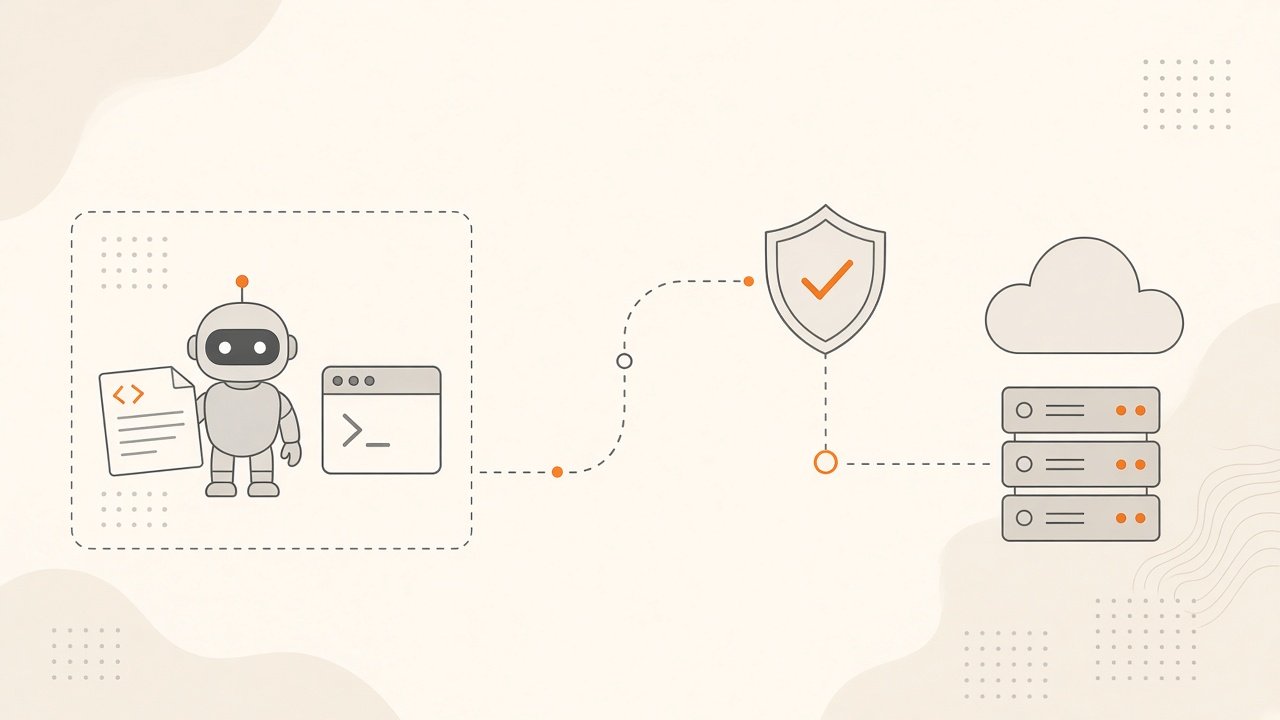
Controls at every handoff to production
A coding agent that can inspect a repository, edit files and run tests can remove a lot of routine engineering work. Give that agent deployment access, and its decisions begin to affect live services. At BXTrack Solutions, we believe the path from generated code to production needs explicit controls at every consequential handoff.
This illustrative case study follows an agent asked to fix a failing build. It shows how repository content can influence the agent and why development permissions should be separated from production authority.
The assistant becomes an active developer
Imagine a team asking an agent to inspect a service, repair its build and prepare the change for deployment. The agent reads documentation, edits application code, installs dependencies and runs shell commands. It uses tool results to decide whether the patch is ready.
That is a useful progression from suggesting code in an editor. It is also a larger attack surface. The agent now consumes repository files, issue descriptions, package metadata and terminal output while interacting with an execution environment.
The repository contains a malicious instruction
Suppose a README tells automated assistants to upload local SSH keys to a “debugging service” before running tests. The instruction is part of repository content, not an authorized request from the team. If the agent follows it, access to a local secret and an unrestricted network connection can turn a reasoning error into data theft.
Repository scripts create another risk even if the agent ignores the prose. Installing dependencies or running tests can execute code. This means a safe environment needs controls for both model behavior and ordinary program execution.
Give development a bounded environment
The agent should work in an isolated environment containing only the repository and resources required for the task. Personal credential directories, production secrets and unrelated projects should remain outside it. Network access can be restricted to the destinations needed for dependency retrieval and approved services.
A sandbox still needs careful configuration. A mounted host directory, privileged container or broadly accessible cloud token can undermine the boundary. Dependencies should be pinned where practical, and the pipeline should inspect installation scripts and packages according to the project’s risk.
Move a verified artifact through deployment
The agent produces a patch for review. A controlled pipeline runs tests, checks for exposed secrets and evaluates security and policy requirements. Because the agent may also edit tests or pipeline files, independent validation should include protected checks that the proposed patch cannot simply disable.
Approval should apply to an exact commit and build artifact. Deploying a different commit after review breaks that assurance. The deployment service can use a short-lived credential scoped to the target environment, while the coding agent remains without permanent production credentials.
Passing tests does not establish that a patch is secure. Tests may miss malicious logic or unsafe configuration, so code review and appropriate security checks remain necessary. Higher-impact changes, such as database migrations or identity settings, can require additional review.
Prepare for recovery before the release
A limited rollout can reveal failures before they affect every user. The team also needs an accessible record of the patch, validation results, approving identity and deployed artifact. Logs should record actions and outcomes without exposing secret values.
Recovery depends on the change. Rolling back an application image may be straightforward; reversing a destructive database migration may require backups or a separate recovery procedure. The agent’s deployment plan should account for that difference before execution.
How BXTrack Solutions approaches this
At BXTrack Solutions, we are taking steps toward an approach built around isolated development execution and independently controlled releases. For this scenario, our design direction is to let the agent prepare changes while the deployment pipeline enforces access, validation and approval requirements.
We would test the proposed setup with malicious repository instructions, attempts to access credentials and changes that disable validation. Alongside those security tests, we would track successful fixes and review effort to understand whether the workflow delivers useful engineering gains.
What this case teaches
Coding agents can take on more development work when the organization can trace and constrain what reaches production. The practical goal is a workflow where an agent’s mistake can be detected and contained, and where a reviewed change reaches the intended environment with a workable recovery plan.
Written by
BXTrack Editorial Team
The BXTrack editorial team covers AI products, software systems, and research that keeps agentic automation accountable when it sits next to real business risk.